My long-term experience with the original RGBM-based Mares Quad, why it remains my trusted backup after extensive use, and how it differs from the newer Bühlmann-based Quad 2 and Quad CI.
Why an old backup remains in service after an extraordinary amount of use. Dive computers are useful only when the diver understands what role each one has in the plan—and which decompression model is actually running inside it.
What I want from the display
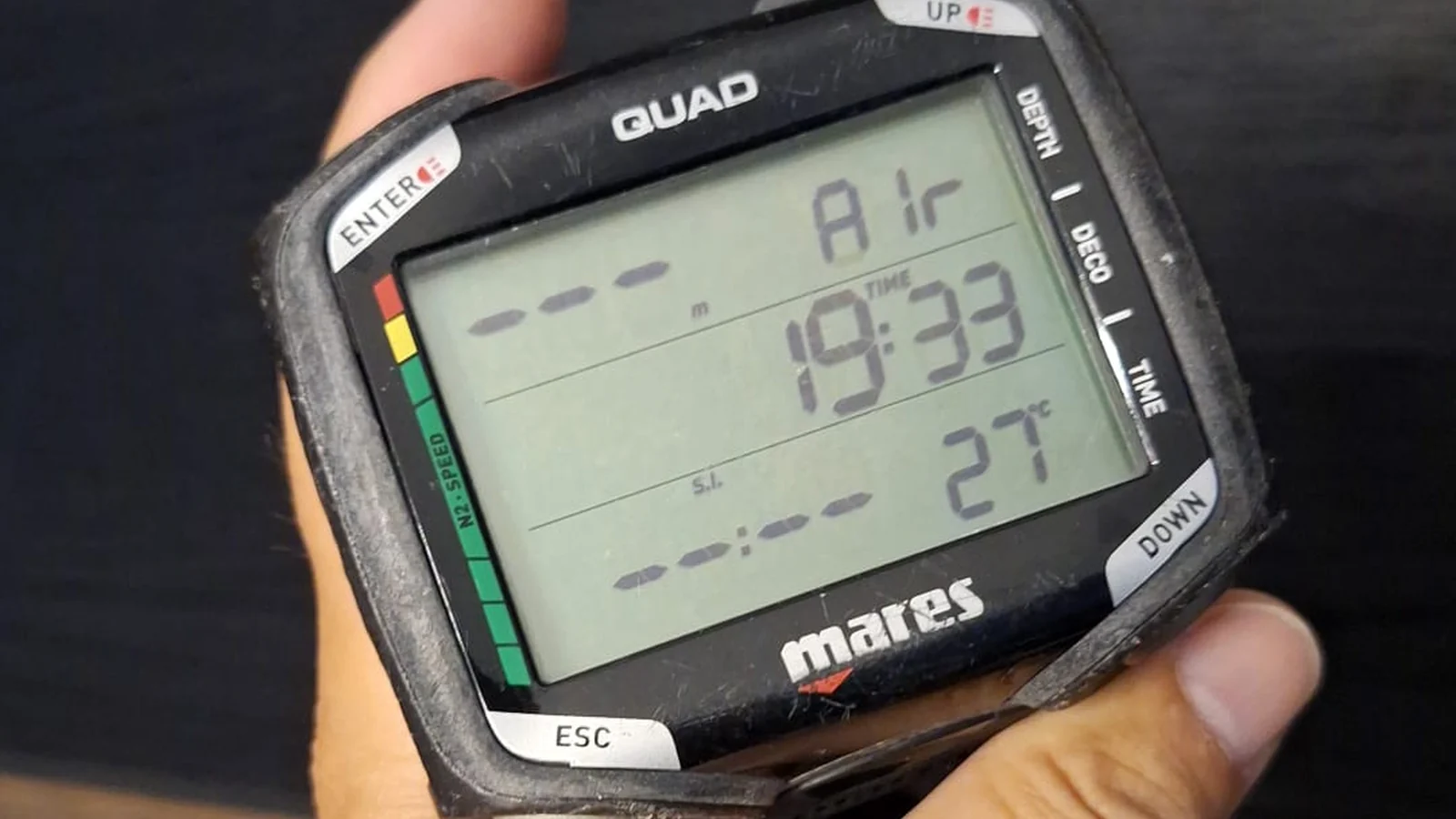
My Mares Quad has accumulated roughly 1,400 dives in my use; its dive counter stopped being useful after 999. The display is large, the computer has been dependable and the battery life has been so good that replacing it has never felt urgent.
I have been tempted by newer Quad-family products and newer decompression implementations, but working equipment has a strong argument of its own. This is one of the clearest examples in my kit of refusing to upgrade simply because marketing says time has passed.
The practical point
The screen is useful, but the real safety feature is still the diver who understands the information and has a plan for losing it.
The original Quad earned its place by surviving use
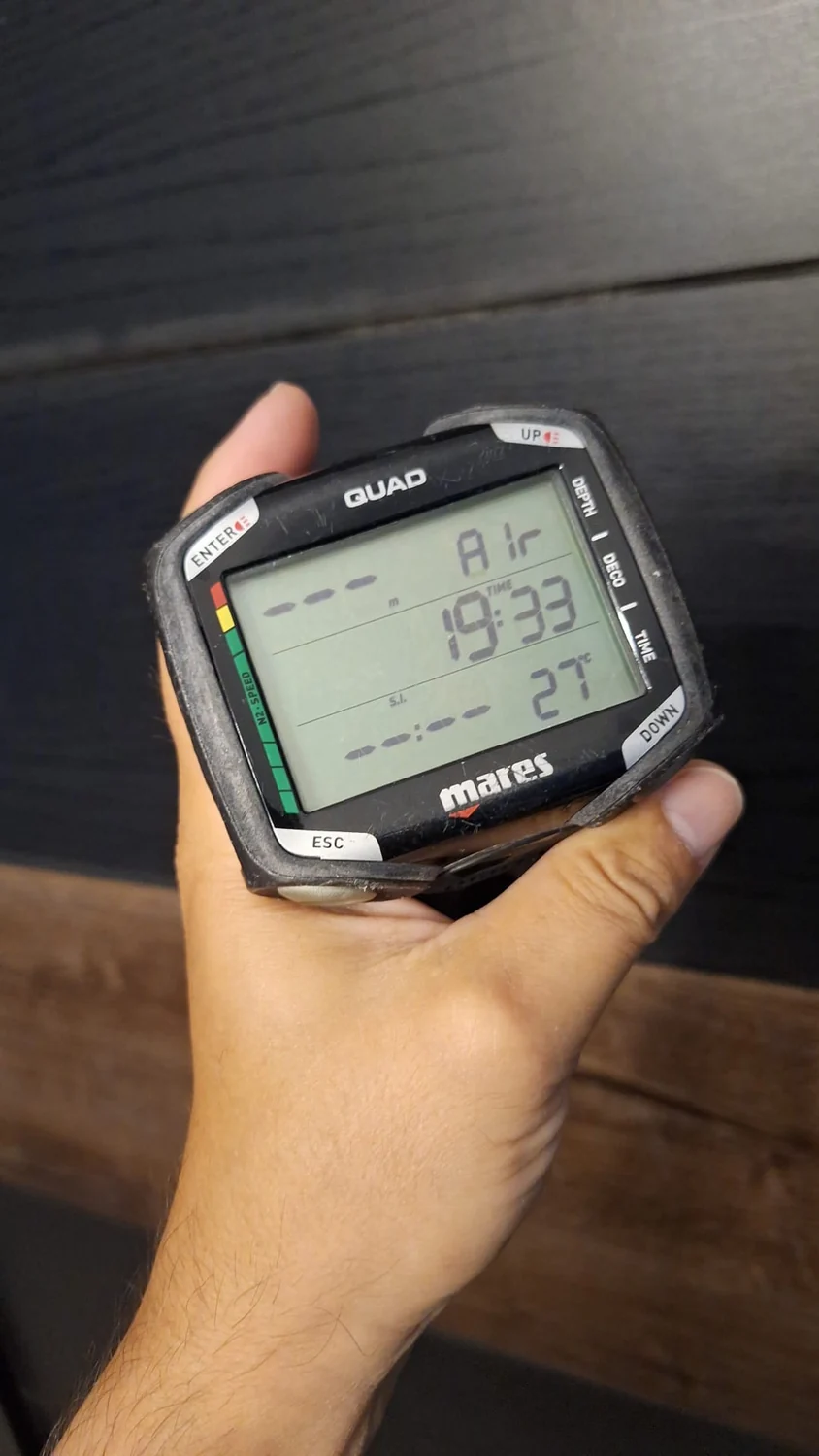
My backup is the original Mares Quad. It has accumulated roughly 1,400 dives in my use, enough that the older dive-counter behaviour became almost a joke to me. What keeps it in service is not nostalgia. The large display remains easy to read, the computer has been extraordinarily dependable in my use and I dislike replacing equipment that is still doing its job.
This is where the model-name distinction matters. The computer I use is the original Mares Quad, from the Mares-Wienke RGBM generation. It is not the newer Quad 2. Mares’ own 2024 product catalogue lists the original Quad under RGBM, while the current Quad 2 is a later Bühlmann ZH-L16C model. My long-term experience in this article therefore belongs to the RGBM-based Quad I actually dive, not to the current Quad 2.
A computer gives information; the diver still makes decisions
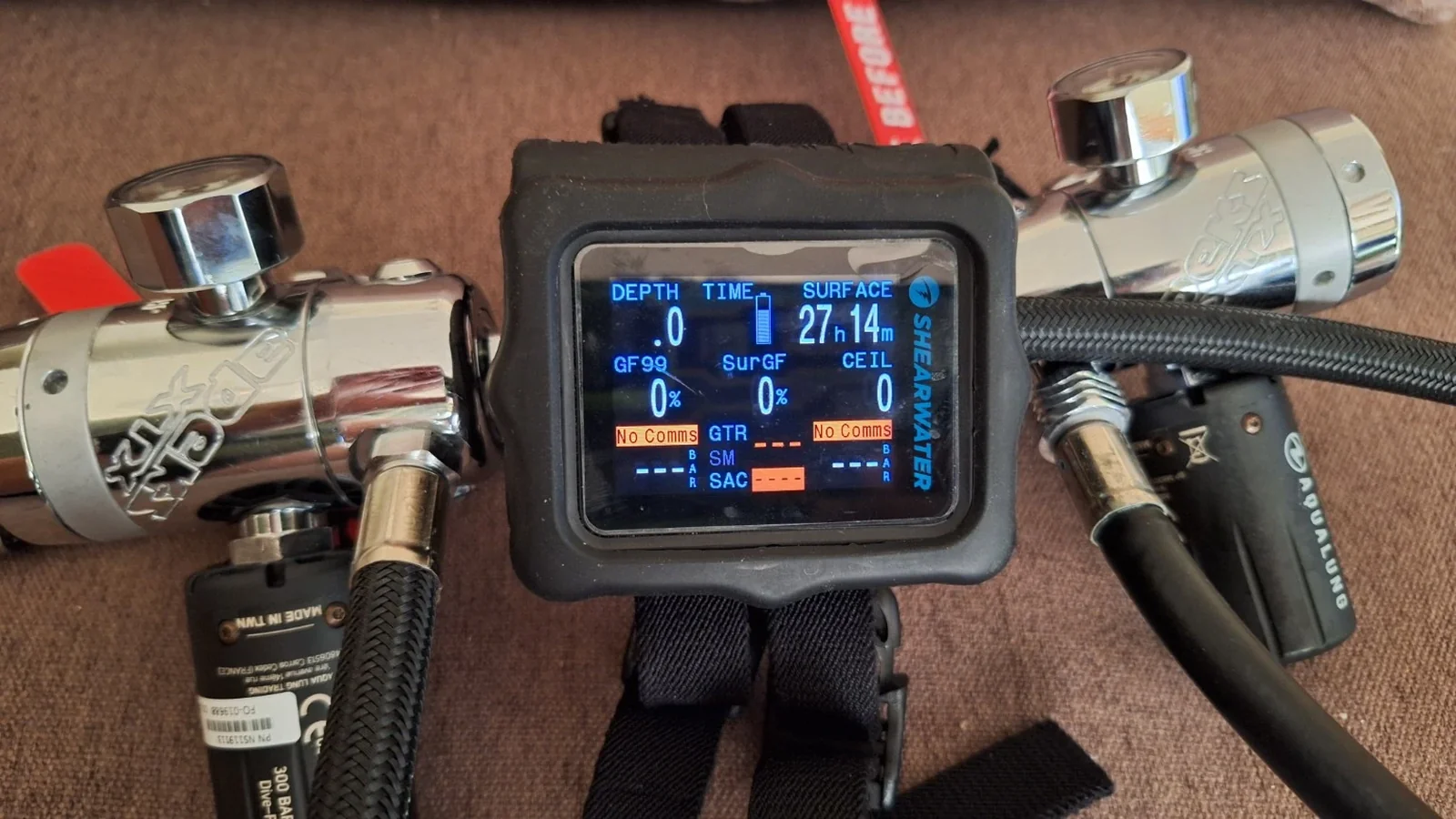
I like powerful dive computers, but I do not want them to become black boxes. My original Quad uses RGBM; my Perdix 2 uses Bühlmann ZHL-16C with configurable gradient factors. Those are not interchangeable descriptions of the same computer. Terms such as no-decompression limit (NDL), TTS, GF99 and SurfGF should mean something to the diver, but not every computer exposes the same information or the same adjustment tools.
NDL and Time To Surface are predictive outputs. They are calculated from the computer’s model, current profile and assumptions; they are not promises about biology. TTS can include predicted ascent and required decompression based on enabled gases and the programmed ascent behaviour. This is why I use the screen as a decision tool rather than an authority detached from the dive plan.
Air integration adds context, not permission
With transmitters, pressure can be related to recent consumption and depth. Shearwater can calculate SAC and Gas Time Remaining, and its current sidemount support can track multiple cylinders and provide switch prompts. GTR is useful but it does not replace technical gas planning: Shearwater’s own documentation explains that it is based on a direct ascent with reserve assumptions, does not include safety or decompression stops, and is unavailable once required decompression is present. That is exactly why I describe it as additional information.
Redundancy changes with the type of dive
On recreational dives I normally let two computers run independently because I dive frequently and want both to carry their own tissue/loading history. On technical dives the Perdix 2 is the primary decompression computer and the Mares Quad can be used in gauge mode together with written backup tables/wetnotes. Those are different redundancy strategies because the dives are different.
What I want the diver to understand before the display
A beautiful screen is useful only if the diver knows what the numbers are telling them. I want to know which algorithm is running, which gases are enabled, what reserve assumptions affect gas calculations, how ascent-rate warnings work and what happens if the computer is lost. That understanding is what turns an expensive instrument into a tool rather than a source of false confidence.
Original Quad vs the newer Quad 2 and Quad CI
The naming is easy to confuse because Mares now sells a model called Quad 2. The current Quad 2 uses Bühlmann ZH-L16C, a large segmented display, built-in Bluetooth, a user-replaceable battery and a published 100-hour logbook capacity. The Quad CI is also a Bühlmann ZH-L16C computer, but with a different display and feature set. Those specifications describe the newer products; they should not be retroactively applied to my original RGBM-based Quad.
Mares — current Quad 2 (Bühlmann ZH-L16C) · Mares — manuals and legacy Quad documentation
Explore related topics
This article stands on its own, but these pages go deeper into the parts that connect directly with it: