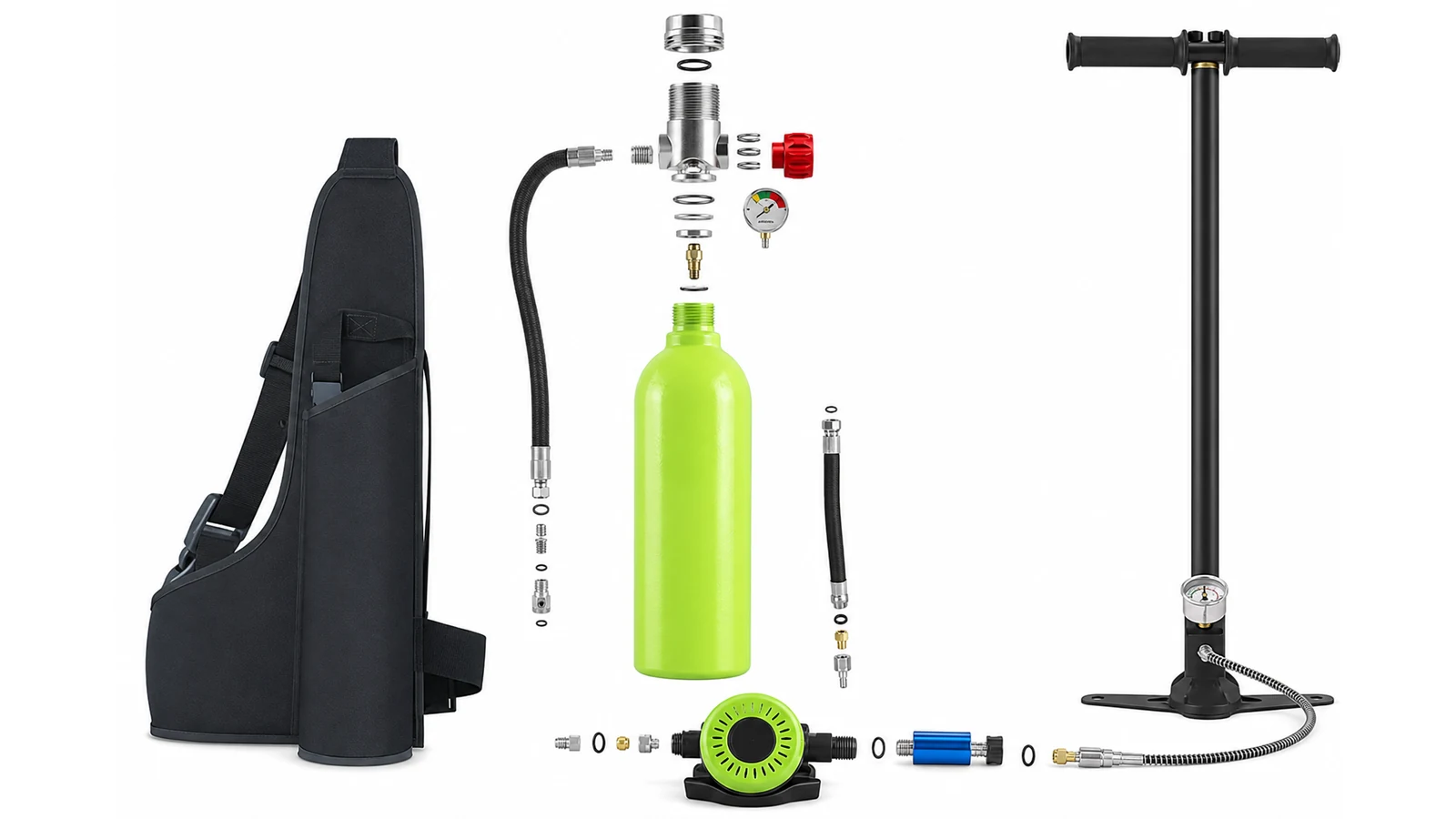
They look clever, compact and reassuringly simple. A tiny cylinder, a regulator, perhaps even a hand pump, and suddenly anyone can apparently “breathe underwater”. The reality is rather different.
Every now and then, someone walks into a dive shop carrying one of these little cylinders.
Usually it is around half a litre or one litre, aluminium or steel, with an integrated first-stage-type assembly on top, a small second stage, a pressure gauge and, very often, a high-pressure hand pump supplied in the box.
The owner has normally bought it online after seeing a video of somebody happily swimming underwater with it.
Then comes the question:
“Can you fill this for me?”
That is normally where things become more complicated.
I have a serious problem with these products. Not because small cylinders are inherently bad, and certainly not because redundant gas systems are bad. Proper pony cylinders have been used by divers for decades and, configured correctly, can be an excellent independent gas source.
That is a completely different subject.
What I am talking about here are the tiny “mini scuba” systems marketed directly to people who may have no scuba training whatsoever, sometimes with advertising that makes breathing underwater look little more complicated than using a snorkel.
As a diving instructor, and also someone who works hands-on with scuba cylinders and regulators, I find some of that marketing deeply misleading and, in the wrong circumstances, potentially dangerous.
The problem starts with how simple they look
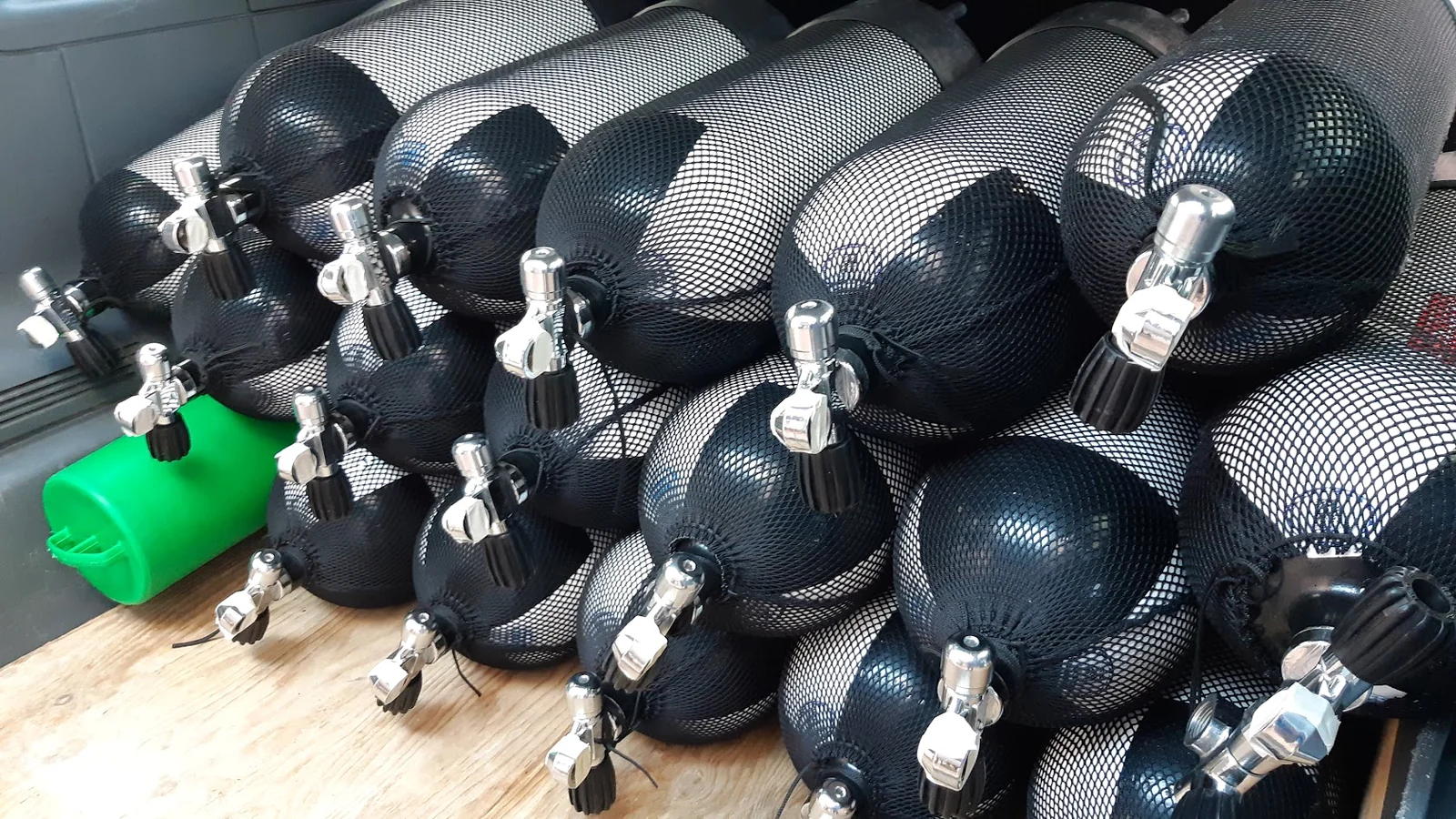
Put a normal 12-litre scuba cylinder and full regulator set next to one of these miniature systems and the psychological difference is obvious.
A normal scuba setup looks technical because it is technical. There is a BCD, regulator, gauges, hoses, weights, cylinder and dive computer. Even somebody who has never dived before can look at it and reasonably assume there is something to learn before jumping into the water.
A one-litre cylinder with a mouthpiece attached creates a very different impression: fill it, put it in your mouth and go underwater.
But the cylinder being small does not change what is happening. You are still breathing compressed gas underwater, and the physics involved are exactly the same.
Your lungs do not care whether the gas came from an expensive regulator system or from a small bottle bought online.
“Ten minutes underwater” is not really an answer
Advertising for these systems often concentrates heavily on how many minutes you can supposedly breathe underwater.
That number, by itself, tells you very little.
Gas consumption depends on depth and on the person breathing it.
Take an idealised one-litre cylinder filled to 200 bar. Ignoring some real-world complications, that represents approximately 200 litres of gas measured at surface pressure.
If someone has a Surface Air Consumption rate of around 20 litres per minute, those 200 litres theoretically represent about ten minutes of breathing at the surface.
At 10 metres, ambient pressure is approximately twice surface pressure. The same diver is now consuming roughly 40 litres per minute, so the theoretical ten minutes have become about five.
Go deeper and the available time becomes shorter again.
Then add swimming, cold, excitement, poor technique, physical effort or panic. An inexperienced person who suddenly becomes frightened can consume gas far faster than a relaxed trained diver.
And, of course, nobody sensible plans to breathe a cylinder completely empty.
So when somebody asks me, “How long does this bottle last?”, the important questions are: at what depth, breathing at what rate, and under what circumstances?
Without that information, a number of minutes printed on an advert does not mean very much.
The hand pump creates another problem
Many of these kits are sold with a manual high-pressure pump, which naturally gives the buyer the impression that the cylinder can simply be refilled at home.
Specialist multi-stage hand pumps capable of reaching pressures around 200 or even 300 bar do exist, so producing that pressure manually is not physically impossible.
My concern is not simply whether the pump can move a gauge needle to 200 bar.
My concern is whether I would want to breathe the gas it has put into the cylinder.
A professional diving compressor does much more than squeeze air.
Air intended for breathing needs to be properly filtered and dried. Diving compressor installations use filtration and moisture-separation systems intended to control water, oil and other contaminants. In Europe, compressed breathing air has defined quality requirements under standards such as EN 12021.
A little hand pump drawing ambient air from a garage, bedroom, boat or humid Maltese summer afternoon is a very different proposition.
Some pumps include small moisture filters and their quality varies, but I would not automatically consider a small consumer filter cartridge equivalent to a properly maintained breathing-air compressor system.
Moisture matters particularly because eventually somebody like me may have to open the cylinder and see what has been happening inside it.
Eventually, the cylinder has to be opened
A scuba cylinder is a pressure vessel. It is not something you simply buy, fill repeatedly and forget about.
Here in Malta, scuba cylinders used in normal diving service are subject to periodic inspection, including regular visual inspection and pressure testing at the required interval. A filling station also needs to care about the cylinder's markings, condition and test status before deciding whether to fill it.
An internal visual inspection means exactly that: the gas is removed, the valve comes off and we look inside.
That is when the attractive little cylinder from the online advertisement becomes a pressure vessel that has actually been filled, stored and breathed from.
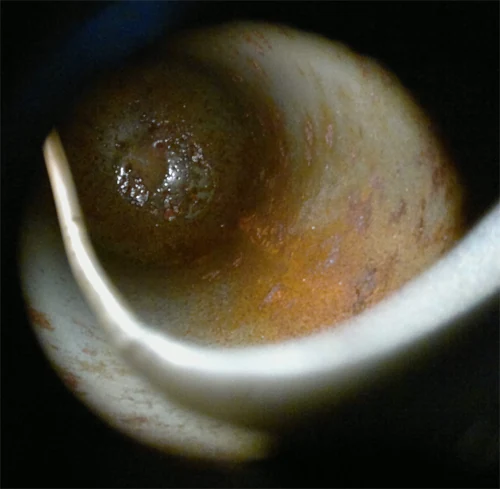
Moisture inside is bad news.
In steel cylinders it can lead to internal rust and eventually pitting. Aluminium does not rust in the same way as steel, but aluminium certainly corrodes and significant oxidation or pitting can also make a cylinder unacceptable for further service.
This is one of the reasons proper breathing-air systems are designed to deliver very dry air. Repeatedly introducing excessive moisture into a high-pressure cylinder is not something I want to see.
The frustrating part is that the outside can still look perfect. Nice paint tells you nothing about the condition of the internal wall.
I have opened enough cylinders to know that what is happening inside matters far more than how attractive they look on the shelf.
The regulator can be an even bigger problem
Even if the cylinder itself is fine, there is still the regulator to deal with.
A normal scuba regulator is a serviceable life-support device.
Take something relatively straightforward such as an Aqua Lung Calypso, or a proper Apeks regulator. It belongs to a manufacturer-supported system. A trained technician can obtain the correct service components, dismantle the regulator, inspect it, clean it, replace wearing parts, reassemble it and test its performance according to the appropriate procedures.
That is exactly what I want from something I expect to breathe from underwater.
With many miniature systems brought to me, the situation is very different.
The top of the cylinder may combine a proprietary valve and first-stage assembly. The second stage can be a generic unit with little or no recognised servicing infrastructure available locally. There may be no practical source for the correct service kit, no clear servicing documentation and no realistic way for a technician to support the unit throughout its life.
The country in which the equipment was manufactured is not the issue. Excellent diving equipment is manufactured all over the world.
The issue is whether a life-support device has identifiable components, proper documentation, available spare parts and a realistic servicing procedure.
If I cannot obtain the manufacturer's service kit, cannot identify the correct parts and cannot service and test the regulator according to an established procedure, I cannot magically turn it into a properly serviceable scuba regulator.
In practical terms, the system can end up becoming disposable.
I find that difficult to accept for equipment somebody is going to breathe from underwater.
Owners sometimes realise this only later and ask whether the integrated assembly can be removed, a normal scuba valve fitted and a conventional first and second stage installed instead.
Sometimes the cylinder thread or construction makes that impossible from the beginning.
Even where a conversion might technically be possible, I still need to know what condition the cylinder is in. If it has spent its life being filled with wet air, opening it may reveal enough internal corrosion that spending more money converting it makes little sense.
Someone can therefore buy a supposedly cheap and convenient kit, struggle with the hand pump, discover that a dive centre is reluctant or unable to fill it, discover that the regulator has no practical servicing route and finally decide to replace most of the system.
By that point the cylinder itself may need cleaning, further evaluation or rejection.
The cheap shortcut can stop looking particularly cheap.
The same applies to filling adaptors. The fact that a technician can physically connect an adaptor to something does not automatically mean that filling it is appropriate. A professional filling station has to consider the pressure vessel itself, its markings, inspection status, condition and connection before deciding whether to put high-pressure breathing gas into it.
The main danger is not the equipment
Everything above is enough to make me cautious about these products, but it is not my biggest objection.
My main concern is who some of them are marketed to.
Imagine someone with no scuba qualification buys one.
They manage to fill it, take it to the sea and swim down several metres. Maybe they reach five metres. Maybe ten.
For the first few minutes the experience is fantastic. They are underwater and breathing. The product appears to work exactly as advertised.
The problem starts when the pressure gauge approaches empty.
If the gas supply stops, that person may never have practised an emergency ascent. They may never have been taught one of the most fundamental rules of scuba diving: if you are breathing compressed gas underwater and ascending, you must not hold your breath.
The natural reaction when somebody suddenly cannot breathe underwater is obvious: get to the surface.
And a frightened person may instinctively hold their breath while doing it.
That combination can be extremely dangerous.
At 10 metres of seawater, the surrounding absolute pressure is approximately 2 bar. At the surface it is approximately 1 bar.
According to Boyle's law, a fixed volume of gas taken from 10 metres to the surface has the potential to expand to approximately twice its volume if it cannot escape.
Human lungs are obviously not rigid balloons, and if the diver continues breathing normally the expanding gas can leave through the airway. But if someone takes a breath of compressed gas at depth and then makes a rapid breath-hold ascent, that expanding gas may not be able to escape properly.
Pulmonary barotrauma can result, and one of the most serious possible consequences is arterial gas embolism.
The counter-intuitive part for somebody with no diving education is that this does not require extreme depth. The proportional pressure change is greatest near the surface, which is one reason the basic rule of continuous breathing during ascent is taught from the very beginning of scuba training.
People also sometimes mix this danger with decompression sickness.
If someone uses a tiny cylinder for only a few minutes at relatively shallow depth, decompression sickness from substantial inert-gas loading would normally be less of an immediate concern than pulmonary over-expansion injury during a rapid breath-hold ascent.
That does not mean uncontrolled ascents are acceptable. Depth, time, repeated dives and the actual dive profile still matter.
But if I were explaining the immediate problem of an untrained person running out of gas at 10 metres and racing for the surface, pulmonary barotrauma and arterial gas embolism would be much higher on my list of concerns than classic decompression sickness.
There is enough genuine risk here without exaggerating it.
Advertising creates the illusion
This reminds me of some advertising I have seen for full-face snorkelling masks.
A full-face snorkelling mask is designed primarily for snorkelling at the surface. With many designs, the user cannot easily access or pinch the nose to equalise the middle-ear pressure in the normal way.
Yet put a model a couple of metres underwater wearing one in an advertisement and the message received by an inexperienced consumer may be very different from the technical purpose of the product.
They do not necessarily think about equalisation or pressure. They simply see somebody underwater and imagine themselves doing the same thing.
Mini scuba systems can create a similar impression.
I completely understand the attraction. Being able to stay underwater and breathe is fascinating. It is probably why most of us became divers in the first place.
But there is a difference between selling the dream of the underwater world and removing so much context that compressed-gas diving begins to look like a beach activity requiring little more knowledge than snorkelling.
If you are a diver, there are better solutions
The ironic part is that if you are already a certified diver and genuinely need an independent redundant gas supply, there are conventional solutions.
Depending on the application, that might be a proper small scuba cylinder of three, four or five litres with a standard scuba valve, combined with a normal reputable and serviceable first and second stage.
Now you have a recognisable pony system. The cylinder can be inspected, the valve and regulator can be serviced, replacement components can be available, the equipment can be filled through normal diving infrastructure and a technician knows what they are looking at.
More importantly, the person using it should already understand gas planning, pressure, regulator use, buoyancy, ascent procedures and emergency management.
That is completely different from selling somebody a one-litre gadget with an implication that training is optional.
And this is where I think scuba training is sometimes misunderstood.
From the outside, certification can look like unnecessary bureaucracy. Someone may reasonably ask why they need to pay for a course simply to put a regulator in their mouth and breathe underwater.
Because using the regulator is probably the easiest part.
Learning to put a second stage in your mouth takes seconds.
The course is about everything else: why your ears hurt during descent and how to equalise, how pressure affects gas spaces, why buoyancy changes, why gas consumption increases with depth, how to monitor the supply, what to do if it fails, how to share gas, how to ascend correctly and how to recognise a developing problem before it becomes an emergency.
That knowledge is the real scuba equipment.
The cylinder and regulator merely make breathing underwater possible.
Why I object to the way these products are sold
I understand why miniature scuba systems are easy to sell.
The marketing almost writes itself: tropical beach, crystal-clear water, somebody slipping beneath the surface without bulky equipment, without a course and apparently without much inconvenience.
It looks like freedom.
But once you breathe compressed gas underwater, the same basic physics that apply to every other scuba diver apply to you.
A one-litre cylinder does not change that. Neither does an attractive advertisement or the word “recreational” printed on the box.
The equipment still needs to be filled appropriately. The cylinder still needs to remain safe internally. The regulator still needs to work. And when the gas eventually runs low, the person breathing from it needs to know what to do.
That is why I object to the way some of these systems are marketed.
I am not against small cylinders, redundant gas or new equipment. I am certainly not against people discovering the underwater world.
Quite the opposite.
Take a scuba course. Learn what happens to your body and your equipment underwater. Understand why some of the things divers do can appear unnecessarily complicated from the surface.
Then, if your diving requires an independent redundant gas supply, choose equipment that can be properly inspected, filled, serviced and maintained.
It may not look quite as effortless in a thirty-second social-media advert.
But when I am underwater and put a regulator in my mouth, I am much more interested in whether it will give me gas when I need it — and whether the person breathing from it knows what to do next.
This article reflects my personal opinion and experience as a diving professional and equipment technician. Miniature compressed-gas systems vary considerably between manufacturers and models. The criticism here is not directed at properly configured redundant scuba cylinders used by trained divers, but at products and marketing that can present compressed-gas diving as a substitute for appropriate equipment, maintenance and training.