From analogue SPGs to dual transmitters — without giving up mechanical redundancy
There is a point when modernising diving equipment stops being about buying the latest gadget.
It becomes about recognising that a technology has matured enough to solve an old problem in a cleaner way.
I think I have reached that point with my sidemount gas management.
For years, my approach was conventional: two independent cylinders, two regulators and two analogue SPGs on short hoses. It works. It is simple, proven and understandable.
There is absolutely nothing wrong with it.
But I have been using Shearwater computers for years, and eventually I started asking myself a question:
Has wireless air integration matured enough for me to trust it as my primary way of monitoring both sidemount cylinders?
For me, the answer is now yes.
The longer story of why I finally came to trust wireless air integration in sidemount is not simply about replacing SPGs; it is about planning before the dive, situational awareness during it and the data that remains afterwards.
But there is an important detail. I did not modernise my configuration by removing redundancy. I modernised it by changing where the redundancy lives.
My starting point
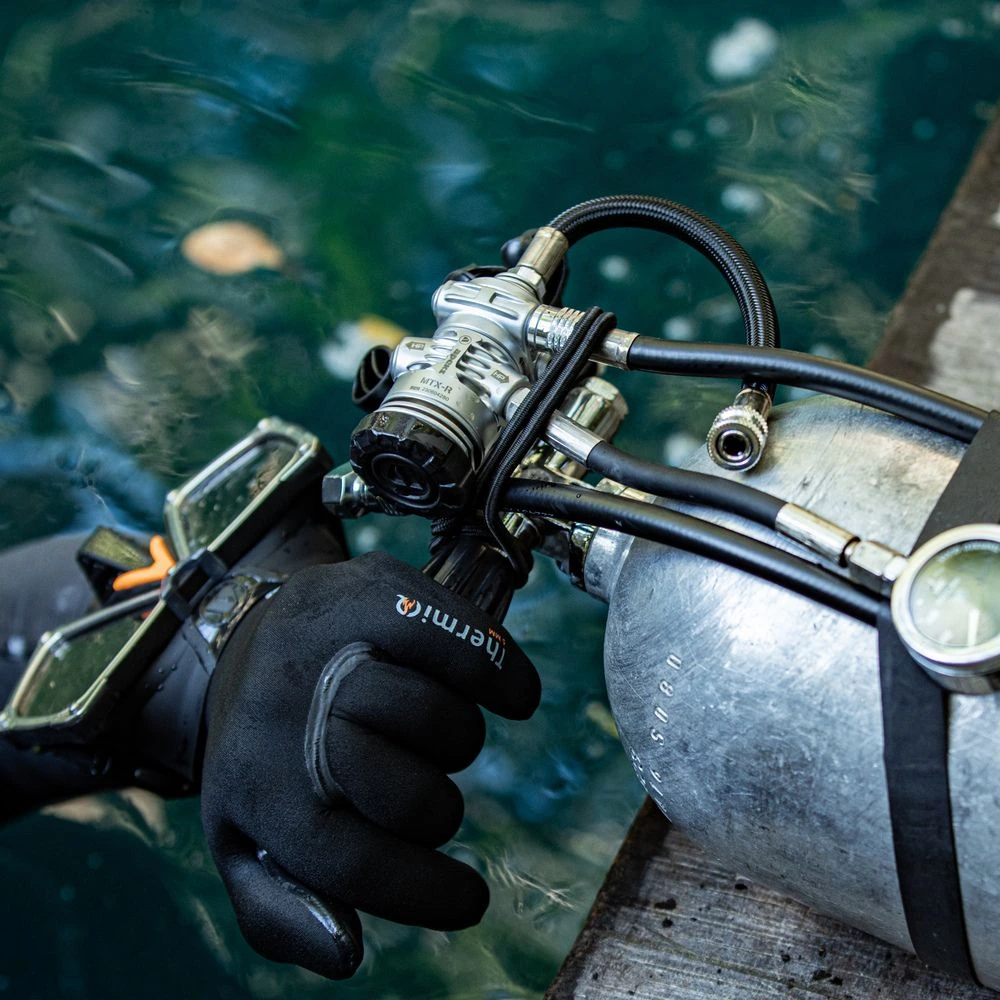
My sidemount regulator configuration uses two Apeks DST first stages with XTX50 second stages.
I like the DST particularly for sidemount because of its rotating turret. The medium-pressure ports are arranged around that turret, allowing the hoses to find a natural route rather than forcing sharp bends or awkward positioning. Apeks itself describes the rotating turret as a way of reducing hose tension and improving hose routing.
For years, each regulator also had its own conventional pressure gauge on a short hose. Again: reliable and perfectly functional. But I never loved the ergonomics.
The gauges were close to the cylinders, where they should be for streamlining, but that also meant that reading them required reaching for them, finding them and often bending the hose towards me.
Nothing particularly difficult.
Just one more physical action every time I wanted information that the dive computer could potentially give me instantly.
And I like things minimal.
The change
So I changed the system. Each cylinder now has its own compatible wireless pressure transmitter, both paired with my Shearwater. I configure the computer for T1 + T2 sidemount operation. And then the magic appears.
Instead of reaching backwards for one gauge and then the other, the information is already where I naturally look:
On my wrist. Left-cylinder pressure. Right-cylinder pressure. And between those simple pressure readings, software can turn the information into something much more useful.
Shearwater’s current air-integrated computers support multiple transmitters, and its sidemount implementation includes cylinder-switch notifications and gas-tracking calculations.
That is when air integration becomes far more interesting than simply replacing an analogue needle with a digital number.
Pressure becomes information
An analogue SPG tells me pressure.
That is its job, and it does it extremely well.
But once the computer knows my pressure, depth and recent consumption, it can begin relating those values to each other.
I can have my cylinder information together with SAC rate and Gas Time Remaining.
SAC is particularly interesting to me because it transforms something I would traditionally calculate or study after the dive into information I can observe while the dive is actually happening.
Am I relaxed? Has my breathing changed? Am I suddenly consuming more gas because I am working against current? Has task loading increased my breathing rate without me consciously noticing? The computer does not answer those questions for me. But it gives me another piece of information with which I can answer them.
GTR is useful — but it is not a gas plan
Gas Time Remaining is one of those features that can look almost magical until you understand what it actually means.
Shearwater calculates GTR using the current depth, reserve pressure and a SAC rate averaged over the preceding minutes. It estimates how long you can remain at the current depth while still having enough gas for a direct ascent to the surface with the selected reserve remaining.
There is a very important limitation.
GTR does not include safety stops or decompression stops, and Shearwater blanks the GTR value when decompression stops are required.
So especially in technical diving, GTR does not replace proper gas planning. It does not replace reserves. It does not replace minimum gas. It does not replace a turn-pressure strategy. It is additional information. And that distinction matters to me. Modernisation should provide the diver with better information, not encourage the diver to stop thinking.
Then there is cylinder balancing
Sidemount adds another gas-management consideration: I do not simply care how much total gas I have. I also care how that gas is distributed between my two cylinders.
Traditionally, I monitor both SPGs and change regulators according to my pressure difference and planned strategy. With sidemount air integration, Shearwater can provide cylinder-switch notifications while tracking the two cylinders. I like that very much. Again, it is a prompt, not a replacement for understanding what I am doing.
The computer does not physically switch regulators for me, and I still need to know which cylinder I am breathing and whether the recommendation makes sense within my plan.
But it removes another small piece of mental bookkeeping. That is exactly where I think technology can improve diving. Not by replacing skill. By reducing unnecessary task loading.
NDL, TTS, SAC, GTR and pressure — together
This is where the configuration begins to feel like a genuinely integrated system to me. My computer was already giving me the decompression information I needed. I have depth. Time. NDL. When applicable, TTS. And all the other decompression information I choose to display.
TTS—Time To Surface—is itself a prediction: Shearwater defines it as the predicted ascent time plus required decompression stops, based on assumptions about ascent rate and use of enabled gases. NDL is also predictive rather than an absolute promise about the future.
Now I can add:
Left-cylinder pressure, right-cylinder pressure, SAC and GTR. Those are no longer separate systems scattered around my body. They are related pieces of information presented together. For the way I like to dive, that is enormously appealing.
Minimalism, not gadgetry
This is probably my favourite part of the whole configuration. It feels pure. I have always liked diving equipment to be clean, minimal and functional. Every component should have a reason to exist. Nothing should be added simply because an empty port is available. And wherever possible, I do not want to perform unnecessary movements underwater just to obtain information.
With my old SPGs, reading cylinder pressure involved reaching back, locating a gauge and bending or pulling the short hose into a readable position.
It worked. But it never felt perfect. Now the primary pressure information is already on my wrist. So what happened to the analogue gauges? They became much smaller.
Redundancy on redundancy
Each DST still carries a small Aquatec button gauge. Those gauges are no longer my normal method of monitoring gas. They are there as mechanical backups. And I have oriented them slightly towards me.

If a transmitter stops communicating, I can look directly at the first stage and see the cylinder pressure.
If the computer itself fails and I lose both digital pressure displays at once, each cylinder still has its own independent mechanical indication.
That is an important distinction: the button gauges provide redundancy for pressure indication. They do not somehow make the complete regulator or cylinder immune to failure.
But for the failure I am trying to cover—loss of electronic pressure information—they give me a beautifully simple alternative.
Digital primary. Mechanical backup. And almost no additional clutter. Redundancy on redundancy.
Protected transmitters, visible gauges
Component placement matters as much as component selection.
A transmitter sticking out from a first stage where it is vulnerable to impact would not feel like an improvement to me.
Neither would installing something that stopped the DST turret doing one of the things I bought a DST for in the first place.
So I arranged the transmitters where they are relatively protected and do not interfere with the turret.
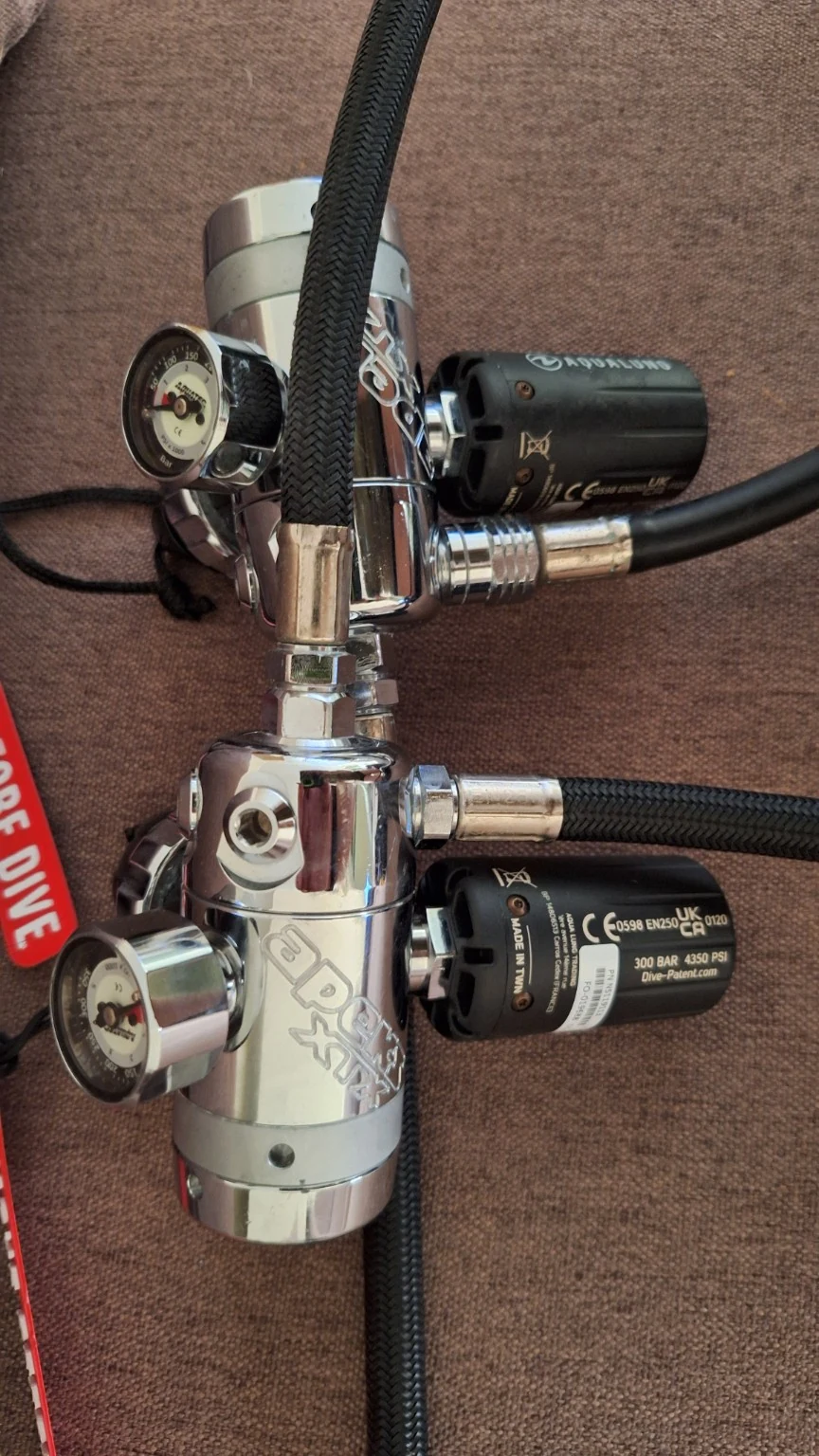
The turret remains free to swivel. The hoses can still move naturally. The small button gauge faces slightly towards me. The transmitter quietly sends its information to the computer. Nothing needs to be manipulated during normal gas monitoring. Looking at the finished regulator set, this is probably what satisfies me most. It does not look as though I have added technology. It looks as though I have removed unnecessary equipment.
Less to handle, more to know
That sounds contradictory, but it describes exactly what I wanted. Physically, I have less to manipulate. Informationally, I have more available. The traditional SPG gave me pressure.
The integrated system gives me pressure and allows that pressure to contribute to SAC, GTR and cylinder-management information while the same computer is already dealing with NDL, TTS and the rest of my dive data.
Current Shearwater computers are specifically designed to work with multiple transmitters, and Shearwater now describes full sidemount support, cylinder-switch notifications and gas-tracking as normal product features rather than experimental additions.
For me, that matters.
I am not interested in being an early adopter simply for the pleasure of owning something new.
I want technology to become mature, predictable and useful before I reorganise an established configuration around it.
I think we are there now.
The photograph that says “No Comms”
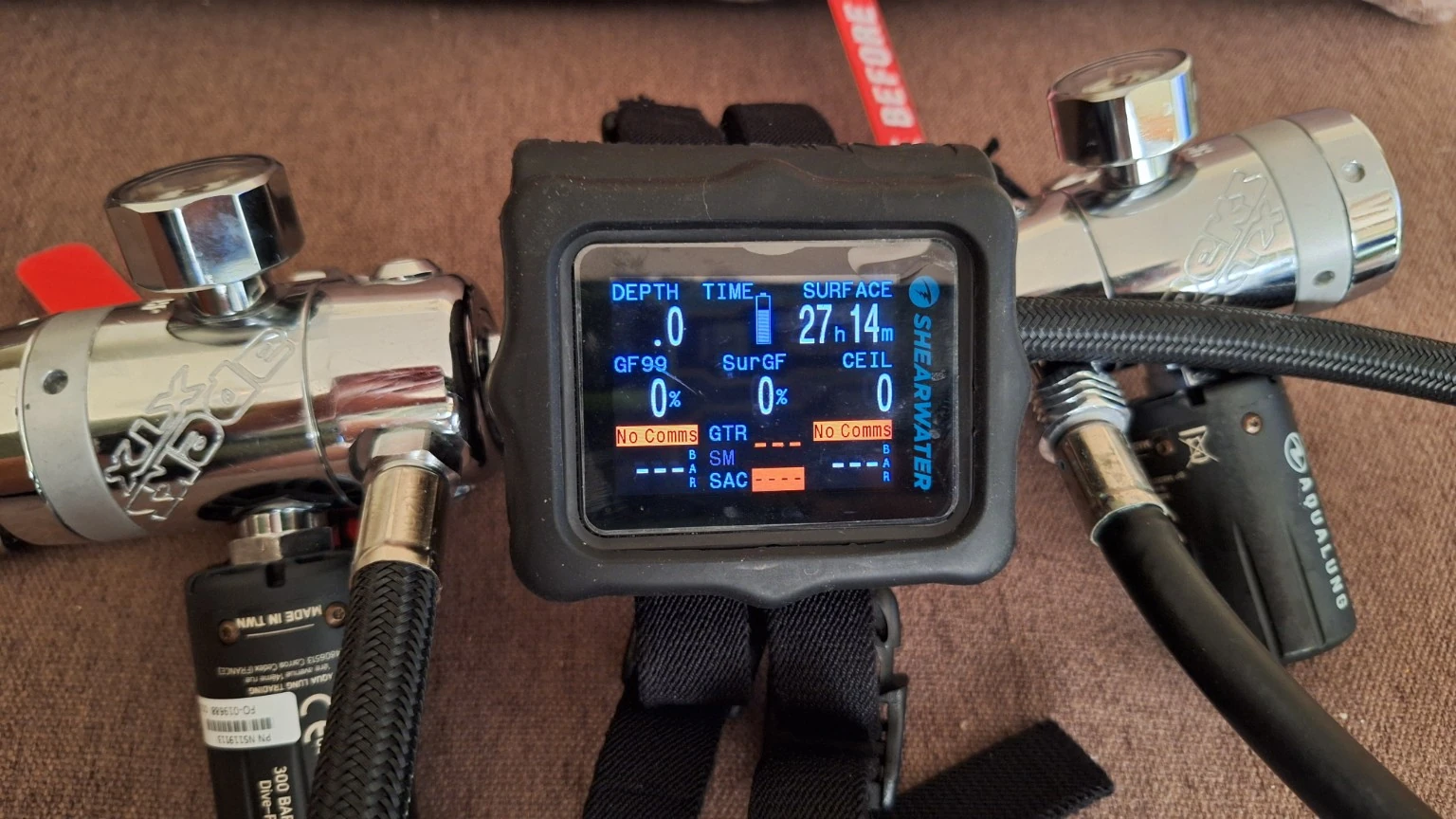
There is something slightly funny about one of the photographs of this configuration. My Shearwater is sitting perfectly between the two first stages, configured for the transmitters... …And both sides say No Comms. There is a simple reason.
I did not have the cylinders with me when I took the photograph, so the regulators were not pressurised and the transmitters were not transmitting pressure.
I actually like keeping that photograph in the article because it shows the configuration honestly.
It is not a staged computer display with invented cylinder pressures.
When the regulators are pressurised in the water, that same screen becomes the information centre I designed the configuration around.
For the wider context, see my complete diving equipment setup and the philosophy behind it.
This is an evolution, not a revolution
Wireless pressure monitoring itself is not new. Neither is air integration. And I am certainly not claiming to have invented a new sidemount configuration.
What changed is my willingness to trust the technology enough to reorganise my own system around it.
That is different.
I have been using Shearwater computers for a long time. I already trust them with information considerably more complex than cylinder pressure.
At some point I realised that continuing to treat wireless pressure data as an optional novelty while trusting the same computer for decompression information did not make much sense for the way I dive.
So I changed. Carefully. Without removing the mechanical fallback.
The dive continues afterwards
There is another part of this that fits naturally with me. I log my dives. Properly.
Air integration means pressure and consumption information can become part of the digital history of the dive alongside depth, time and the rest of the profile.
That gives me another opportunity after surfacing to understand what happened underwater.
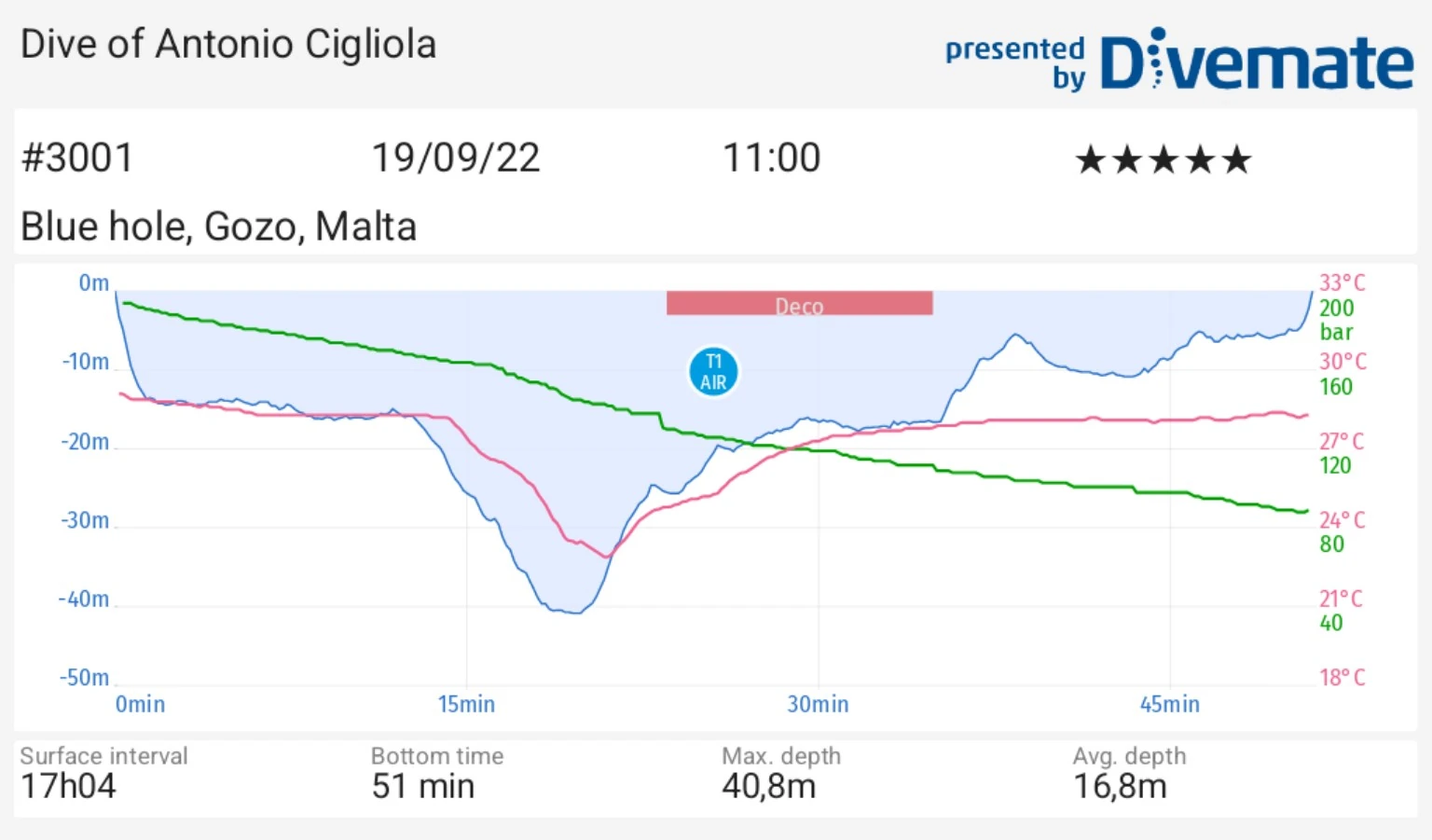
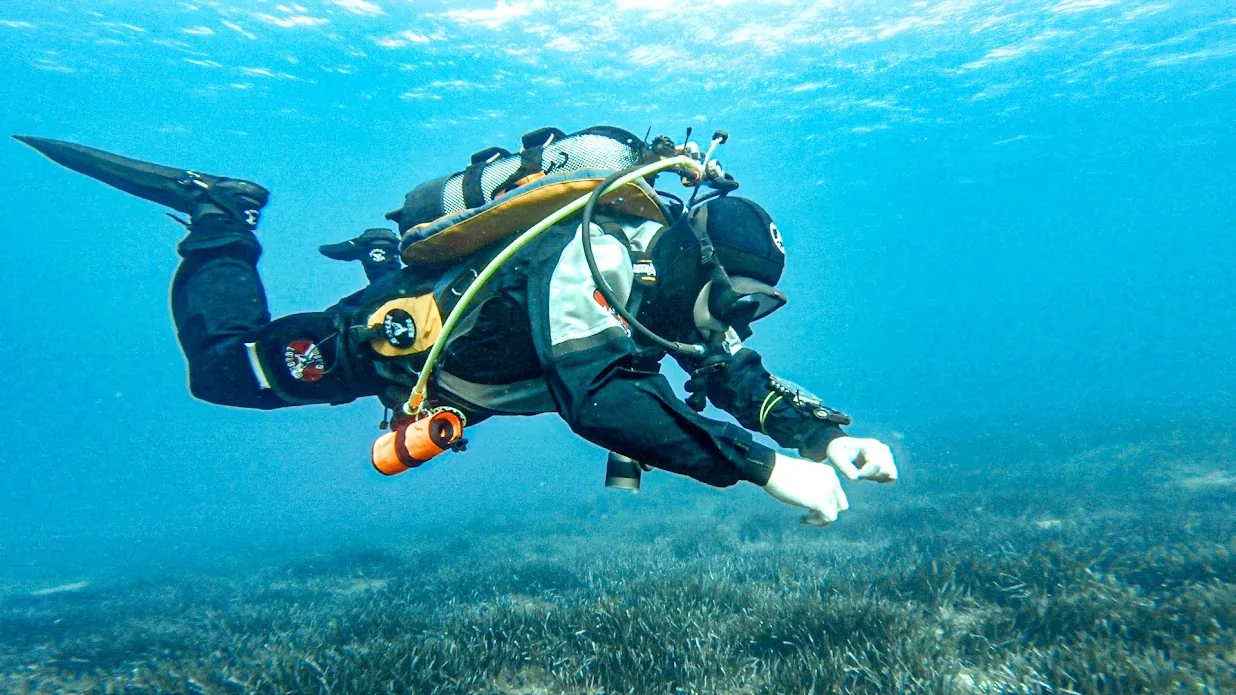
The profile photograph I included from one of my older dives shows exactly why I value this.
I do not just remember that I made the dive. I can go back and look at it. Depth. Time. Profile. Gas behaviour. The dive becomes data without stopping being a memory. That is something I have always appreciated.
Is it the perfect sidemount configuration?
No configuration is universally perfect.
A diver using two conventional short-hose SPGs can have an excellent, reliable and beautifully streamlined sidemount system.
Nothing about my setup makes that configuration obsolete.
And a diver who buys two transmitters without understanding gas planning has not suddenly improved their gas management.
They have simply bought more expensive gauges. Technology should support knowledge. It cannot replace it.
But for the way I dive today, this feels very close to my perfect integrated system.
Two independent cylinders. Two Apeks DST first stages. Two XTX50 second stages. Two wireless transmitters. Two tiny mechanical backup gauges. A clean turret and clean hose routing.
And on my wrist:
Left pressure, right pressure, SAC, GTR, NDL, TTS and the decompression information I need. Less equipment to handle. More information to work with. Mechanical redundancy quietly sitting in the background. That is my idea of modern diving equipment. Not complexity. Not gadgets for the sake of gadgets. Functional minimalism. Sometimes modernisation means adding something. Sometimes it means removing something. And sometimes the best modernisation is when you do both at the same time.