From mechanical gauges to transmitters, redundancy, real-time gas data and a configuration that finally makes sense to me
For a very long time, I was reluctant to put electronics between myself and information I considered fundamental underwater.
Cylinder pressure was one of those things.
I have always been quite conservative when it comes to equipment that has to work underwater. Not because I dislike technology—in fact, quite the opposite. I am fascinated by technology, I read a lot, I like innovation, and when evidence shows that a newer solution is genuinely better, I am usually happy to adopt it.
But I also believe that underwater equipment should earn my trust.
And trust takes time.
This is the story of how I moved from being sceptical about wireless air integration to using two transmitters as an integral part of my sidemount configuration.
Importantly, I did not replace the mechanical system. I built the two together. That distinction is the entire point of this article.
I Wasn't Against Technology. I Was Against Blind Trust.
If you spend enough time reading diving forums, articles and discussions about wireless transmitters, you quickly discover two camps.
At one extreme are divers who believe that the traditional mechanical pressure gauge is the only sensible solution.
Simple. Mechanical. Proven. No batteries, no wireless connection and relatively little to go wrong.
At the other extreme are divers who consider modern electronic pressure monitoring sufficiently mature that the traditional SPG has become almost unnecessary.
I was never completely comfortable with either position.
My instinct is generally to sit somewhere in the annoying middle ground and ask:
What actually works? Not what we have always done. Not what is fashionable. Not what somebody on the internet says is the only correct configuration. What works, for this particular diver, in this particular configuration, for this particular type of diving? That answer took me quite a long time to find.
My Earlier Experiments Didn't Convince Me
I had experimented with electronic pressure monitoring before.
At one point I used a single electronic pressure gauge, such as the Cressi Digi 2, in some of my configurations.
It worked.
But I never felt that the benefit was significant enough to justify changing the way I was already doing things.
A conventional SPG is brutally simple. You look at it. You read the pressure. Done. Sometimes technology technically works perfectly well but does not actually improve the task. If it adds complexity without adding enough value, I am not particularly interested in it. So for quite some time, I went back to conventional pressure gauges. Then sidemount changed the equation.
Sidemount Creates a Different Problem
With a conventional back-mounted cylinder, reading an SPG is simple. In sidemount, you have two independent cylinders. And therefore two independent pressure gauges.
The normal procedure means accessing one gauge, positioning it so you can read it, checking the pressure, putting it back where it belongs, and then repeating the process on the other side.
This is not difficult. But it is a task. And every repeated task underwater has a cost, even if that cost is tiny. It requires movement. It requires attention. It interrupts whatever else you are doing.
A conventional analogue gauge also gives you perfectly adequate information, but usually not information to single-bar resolution.
You might look at it and interpret something around 170 bar.
And for normal gas management, that is generally more than enough.
But a digital system may tell me:
167 Bar. The number itself is not magically safer because it contains three digits. What matters is what the computer can do with that information. That was where things started becoming interesting.
The Configuration I Eventually Built
My current sidemount regulator configuration uses Apeks DST first stages.
One of the reasons I like the DST is its modularity and its routing possibilities. The fifth port and rotating turret make it particularly useful in sidemount, where hose routing matters enormously.
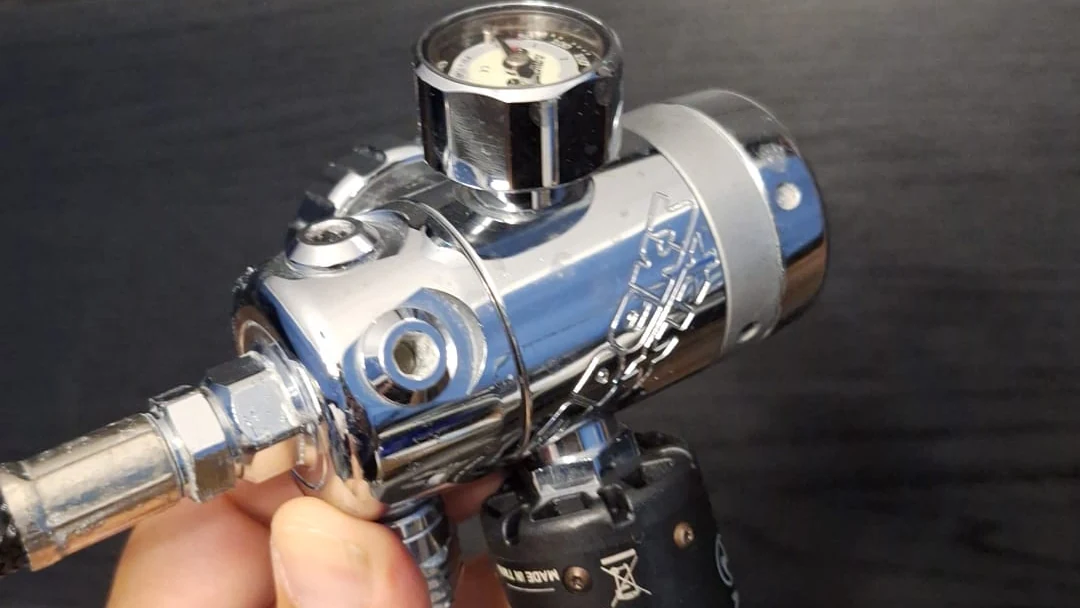
On each first stage I now have two independent ways of obtaining cylinder pressure. The first is an AquaTec button gauge. Small. Mechanical. Simple. Independent of my computer.
The second is an Aqua Lung wireless transmitter, positioned underneath the first stage where it remains relatively protected.
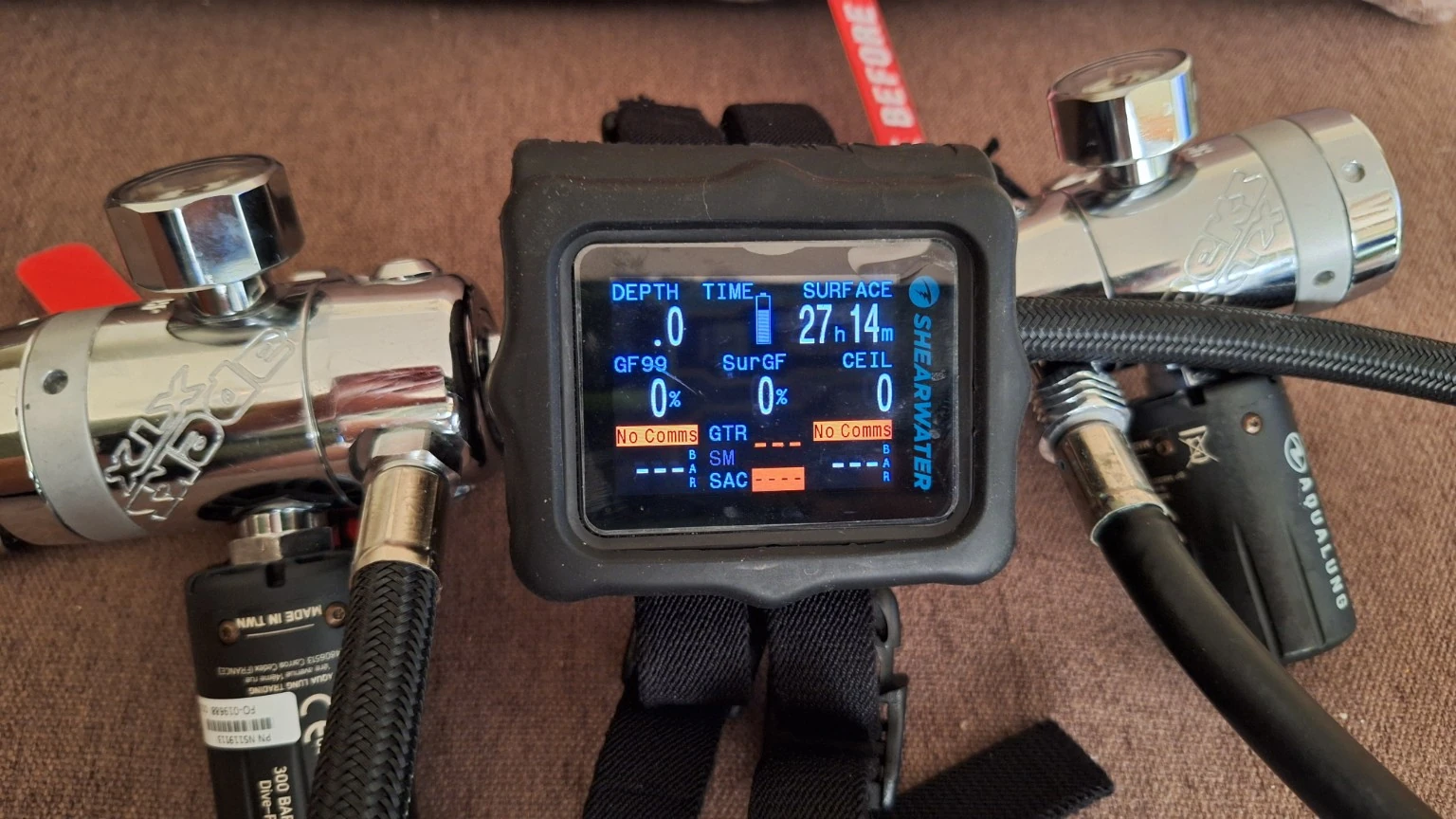
The transmitters communicate with my Shearwater Perdix 2 through its compatible air-integration receiver. Once paired using their individual transmitter identification codes, the Perdix can distinguish between the cylinders and display their pressures independently. Shearwater's current Perdix 2 documentation supports up to four transmitters, and its own technical manual explicitly recommends keeping a backup analogue SPG as a redundant source of pressure information.
So I have not removed the mechanical backup. I have dramatically reduced it. That difference matters.
The small button gauges do not need to provide the same experience as my electronic system. Their purpose is different.
If my computer, transmitter system or wireless pressure information ever becomes unavailable, I still have an independent mechanical indication of cylinder pressure.
That is enough for me to manage the situation. The electronic system is therefore my primary information system. The button gauges are my independent fallback.

That configuration makes sense in my head.
This Is Where DIR and KISS Started Making Sense to Me Again
There is something slightly ironic about using wireless transmitters and then talking about principles associated with DIR—Doing It Right—or KISS—Keep It Simple, Stupid.
Some people will immediately see electronics and think:
"That isn't simpler."
But simplicity is not necessarily the same thing as having fewer electronic components.
To me, simplicity is about reducing unnecessary actions, reducing clutter and creating a system whose failure modes I understand.
I am not claiming that my configuration represents a canonical DIR configuration.
It doesn't need to.
What interests me are some of the underlying ideas that have influenced good diving configurations for decades:
Standardisation, predictability, clean routing, redundancy where it matters, elimination of unnecessary equipment and the ability to deal with a failure without turning it into an emergency.
Seen from that perspective, my configuration starts making a lot of sense. Two independent cylinders. Two independent regulators. Two independent transmitters. Two tiny independent mechanical pressure references. One computer presenting all the primary information in one location. Nothing dangling around unnecessarily. Nothing that I have to retrieve unless something has gone wrong. That feels very KISS to me. Not because the technology is primitive. Because the interaction with the technology is simple.
Before the Dive: Planning
The first benefit of this system happens before I enter the water. I still plan the dive. Technology has not replaced planning. It should never replace planning.
I know how much gas I have available, what reserve I want, what the expected profile is and what limits are relevant to that particular dive.
For recreational diving, I may configure a reserve around 50 bar.
For more demanding or technical dives, I may work with a different reserve—often around 66 bar in some of my plans, depending on the gas strategy. That is a personal planning example, not a universal reserve rule.
Those values do not magically become correct because a computer displays them. They come from the dive plan. The computer simply knows what I have told it. And that distinction is important. The plan exists before the electronics become useful.
During the Dive: Turning Gas Pressure Into Situational Awareness
This is where the system becomes genuinely powerful.
On the Perdix 2 I can see the pressure in my left cylinder and the pressure in my right cylinder.
They are visually separated. I do not have to retrieve an SPG from either side to obtain the information. But cylinder pressure is only the beginning. The computer can combine gas information with other information about the dive. I can see my SAC rate. I can see my remaining gas information.
I can see the calculated time until my selected reserve. On the Perdix 2, Gas Time Remaining is based on recent SAC and asks a very specific question: how long could I remain at the current depth before a direct ascent would bring me to the surface with the selected reserve still available? It does not include a safety stop, and Shearwater does not display GTR when decompression stops are required. That is why I treat it as additional situational information, never as a technical gas plan.
At the same time, I have decompression information such as my NDL, or during decompression diving, information such as TTS—Time To Surface. Both are predictive values: they depend on the model, the current dive state and assumptions about what I will do next. They are useful because I understand those assumptions, not because the screen can predict biology.
Now something interesting happens.
Instead of asking:
"How much gas do I have?"
I can start asking:
"What does the amount of gas I have mean in relation to the dive I am actually doing?"
Those are very different questions.
Imagine that my no-decompression limit tells me I theoretically have plenty of time remaining at this depth.
That information is useful.
But perhaps my current gas consumption tells another story.
Or perhaps the opposite is true: gas is abundant, but decompression obligation is becoming the real limiting factor.
By seeing those values together, I gain a better picture of the dive. Depth. Time. Decompression. Cylinder pressure. Consumption. Gas reserve. These are no longer isolated numbers. They become context. And context is what allows a diver to make better decisions.
The Important Number Isn't Always the Pressure
This was probably one of the biggest changes in how I started thinking about air integration.
A pressure gauge answers:
How much gas is currently inside the cylinder?
An integrated system can help answer a much more useful question:
Given the way I am breathing right now, how useful is that gas to me? Those are not the same thing. Two divers can both have 150 bar remaining and be in completely different situations. Even the same diver can have completely different gas consumption from one dive to another. Cold. Current. Workload. Stress. Equipment. Trim. Swimming speed. Physical condition. Season. All of these things can influence breathing and gas consumption. That is why seeing a calculated SAC rate during the dive fascinates me.
It gives me another piece of information about what is actually happening rather than what I expected to happen.
Planning Is a Prediction. The Dive Is Reality.
This distinction is important. Before an immersion I create a plan based on assumptions. During the dive, reality starts producing data. That does not mean I abandon the plan because my computer gives me new numbers. It means I can compare the plan with reality. That is a much more intelligent use of technology.
I can think of the process in three phases:
Before the dive: plan. During the dive: observe and adapt. After the dive: analyse and learn.
For me, this is where electronic gas monitoring becomes far more interesting than simply replacing an analogue needle with a digital number.
After the Dive: The Part I Had Underestimated
Before using the system properly, I had not fully appreciated how useful the post-dive data would become.
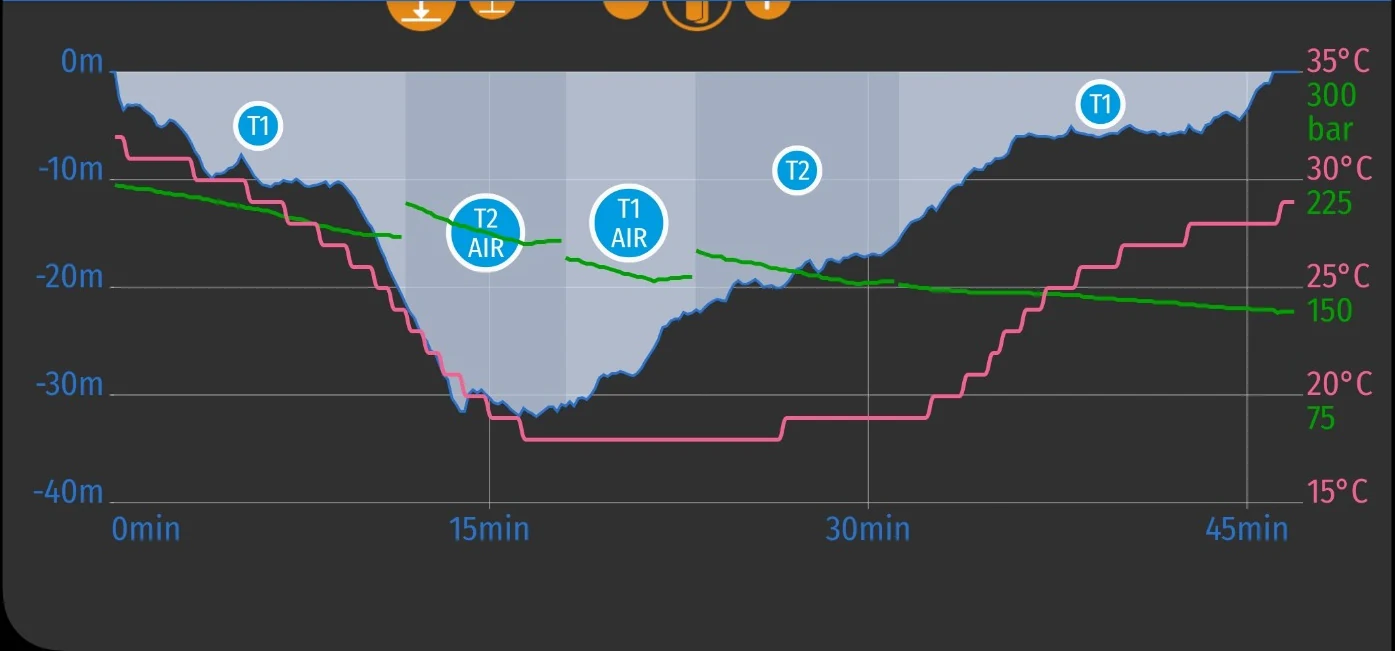
This may now be one of my favourite parts of the entire configuration. After the dive, the logbook contains far more than maximum depth and dive time. I can look at the profile. I can look at temperature. I can look at the evolution of cylinder pressure. I can see which cylinder I was breathing from. I can identify switches between cylinders. I can analyse consumption during different parts of the dive. I can compare dives. And suddenly my logbook becomes useful again in a completely different way.
Instead of manually estimating a SAC rate once in a while, I can start building a history.
How does my gas consumption change in winter? What happens when I am working harder? What happens when I am guiding? What happens when I am perfectly relaxed?
How different is my consumption at the beginning of a season compared with periods when I am diving constantly?
How does equipment change it? How does a DPV change it? How does a demanding dive compare with an easy recreational dive? Those questions interest me enormously. Because the point of collecting data is not collecting data. The point is learning something from it.
A Real Dive Log Tells the Story Better Than I Can
One of my recent dives produced a log that illustrates this perfectly. The graph shows the depth profile across the dive, together with temperature and cylinder-pressure data. More importantly, it shows the transitions between the two sidemount cylinders. You can actually follow the gas strategy through the dive. You see the descent. You see the deeper portion. You see the ascent. You see which tank is being used. You see the pressure evolution. You see the moments when the active cylinder changes.
The Perdix also notifies me around cylinder switching, which makes the whole system surprisingly intuitive in actual use.
Looking at that graph afterwards is almost like replaying the dive from another perspective. The dive is no longer only something I remember. It has become something I can examine.
And I Still Have Two Mechanical Gauges
This deserves repeating. My enthusiasm for the electronic system has not convinced me to eliminate mechanical pressure information completely. That would not fit the way I personally manage risk. Electronics fail. Mechanical equipment fails too. Nothing has a zero failure rate.
The relevant question is not:
"Can this fail?"
Everything can.
The better question is:
"What happens next if it fails?" If a transmitter stops communicating, I have another pressure reference. If the computer stops displaying cylinder pressure, I have another pressure reference.
If the entire electronic pressure-monitoring system disappears from my dive, I have not lost the ability to know whether there is gas in my cylinders.
My dive may change. My plan may change. I may terminate the dive. But the loss of a convenience does not automatically become an emergency. That is the kind of redundancy I like.
Redundancy Doesn't Mean Duplicating Everything
This also connects with my general equipment philosophy. I dislike carrying things underwater simply because they might possibly be useful. I don't want to become a Christmas tree full of equipment. Redundancy should solve a defined failure. It should not exist merely to make a configuration look technical. My transmitters provide an excellent primary interface. My button gauges solve a specific failure mode. That is enough for what I am currently asking the system to do. This is one of the reasons I find the configuration elegant. There is a purpose for everything.
What I Still Don't Know
Another thing I want this article to be clear about is that my experimentation is not finished.
There are still scenarios I need to test.
For example, what is the cleanest way to configure the system when I am doing a recreational sidemount dive with only one cylinder?
Should I disable the second-cylinder display? Will the computer simply show a lost transmitter? Will that create an unnecessary warning or annoyance? I know how to solve the problem conceptually. What I don't yet know is which workflow I will prefer after actually using it repeatedly. The same applies to more complex technical configurations. What happens when I add a stage cylinder? How do I want the additional transmitter displayed? When do I want to switch active gas information? How do I want the logbook to represent it? These are not disadvantages yet. They are questions. And there is an important difference. I could sit at home and invent an opinion about those scenarios. Or I can go diving, test them, and then form one. I prefer the second option.
Experience Should Change Your Opinions
Perhaps this is the part of the story I care about most. I spent a long time being sceptical of wireless pressure monitoring. That scepticism was not stupid.
At the time, based on what I knew, what I had used and what I had observed, it made sense.
Then the technology improved. My equipment changed. My diving changed. My experience with the Perdix 2 accumulated. The system repeatedly demonstrated reliability to me. My requirements also changed because sidemount made the advantages of centrally displayed gas information more relevant. So eventually my opinion changed. I don't consider that inconsistency. I consider it exactly what should happen.
If new evidence, better technology or better experience never changes your opinion, you are not defending knowledge.
You are defending an identity.
And I have very little interest in doing that.
Science, Technology and Diving Tradition
Diving is full of traditions. Some are excellent. Some exist because they solve real problems. Some existed because, forty years ago, they were the best available solution.
And some remain alive mostly because somebody taught them to somebody else who taught them to somebody else.
The fact that something has always been done in a particular way is not proof that it remains the best way to do it.
At the same time, "new" does not automatically mean "better". That is why I like the middle ground. Keep what works. Question what does not. Test new solutions carefully. Understand the failure modes. Create backups where the consequences justify them. And then go diving.
Technology Should Not Replace Judgement
If I had to summarise my current opinion about air integration in one sentence, it would probably be this:
Technology should not replace a diver's judgement. It should improve the diver's situational awareness. The transmitter does not manage my gas. I do. The Perdix does not decide when I turn the dive. I do. A SAC calculation does not replace understanding gas consumption. A GTR estimate does not replace planning. TTS does not replace decompression knowledge. NDL does not give me permission to stop thinking. They are information. Good information.
And when good information is presented clearly, without forcing me to perform unnecessary physical tasks to obtain it, it becomes extremely useful.
Before. During. After.
This is probably the simplest way I can describe what I now like about the system.
Before the dive
I plan. Gas. Reserve. Profile. Limits. Contingencies.
During the dive
The computer gives me updated information about what is actually happening. Cylinder pressures. Gas consumption. SAC. GTR and reserve information. NDL or TTS. The plan meets reality.
After the dive
I analyse. The pressure curves remain. Cylinder switches remain. Depth remains. Temperature remains. Consumption remains. The dive becomes data I can learn from. And then some of that knowledge goes into planning the next dive. The cycle starts again.
So, Would I Recommend Wireless Air Integration?
That is deliberately the wrong question. I can tell you what I use. I can tell you why I use it. I can tell you why I initially rejected it. I can tell you what eventually changed my mind. But I cannot tell another diver that this is automatically the correct configuration for them. Different diving. Different equipment. Different experience. Different attitude toward redundancy. Different risk tolerance.
What I can say is that today, for my sidemount diving, my configuration of two independent transmitters backed by two tiny mechanical gauges feels extremely logical.
It gives me more usable information while reducing the amount of equipment I need to manipulate during the dive.
It keeps a completely independent mechanical way of checking cylinder pressure. It records information that I can analyse afterwards. And perhaps most importantly, I understand what happens if part of the system fails. That is enough for me.
The Configuration in One Sentence
Two independent cylinders, two independent regulators, two wireless pressure transmitters, two minimal mechanical backups, and one computer that turns all of that information into a coherent picture of the dive.
Modern? Definitely. Perfect? Nothing is.
But after taking a long time to trust it, I can say that—for the way I dive today—it makes an enormous amount of sense.
And if future experience proves that part of it can be improved, I will change it again.
That is not a weakness in the configuration.
That is the entire philosophy behind it.
Disclosure
This article describes my personal equipment and my personal experience underwater. I work in the diving industry and sell some of the products and brands I use, but this article is not sponsored. The equipment discussed here was not provided to me in exchange for promotion, and much of my diving equipment was purchased before I ever started selling diving products.
Nothing in this article should be interpreted as a universal equipment prescription or a replacement for proper training, dive planning, manufacturer guidance or appropriate technical-diving procedures.
Dive. Observe. Question. Learn. Adjust. Repeat.